 ProductPost 360
Blog
Can an answer engine read the page?
The readiness audit checks the homepage for robots.txt, llms.txt, headings, and JSON-LD. It reads the page. It does not ask the answer engines.
A mention rate tells you what the engines said. It tells you nothing about whether your homepage is readable when a crawler shows up. The readiness audit is that second check. It fetches the homepage, robots.txt, and llms.txt, and it scores what it found. It does not ask ChatGPT, Gemini, or Perplexity anything.
Run audit is free, and you can run it whenever the page changes. Run now is the prompt check, limited to once every 7 days, and that run refreshes the audit as well. Keep them straight. A green audit with a quiet engine is a normal week. A failing audit with a healthy mention rate is also a normal week, and it is the one people skip.
What the check looks at
The list is short on purpose. These are the things a crawler, or a parser, can get wrong without any model being involved.
- robots.txt for the bots that fetch pages for answers: GPTBot, OAI-SearchBot, PerplexityBot, Google-Extended, and ClaudeBot. A missing robots.txt is treated as allow. A
disallow: /aimed at one of those names is a block, and the row fails. - llms.txt at the root of the site. A file that says what the product is, in plain text, for tools that look for it.
- A single H1, and a heading order that does not jump around.
- A meta description long enough to be a description.
- A visible publication or update date, when the page has one in its metadata.
- JSON-LD for an organization, and for a product or software application, so a parser can see that the page is a product made by someone. FAQ markup is on the list too. A missing FAQ fails that row, and the note calls it helpful, so you can leave it if the page has no questions worth marking up.
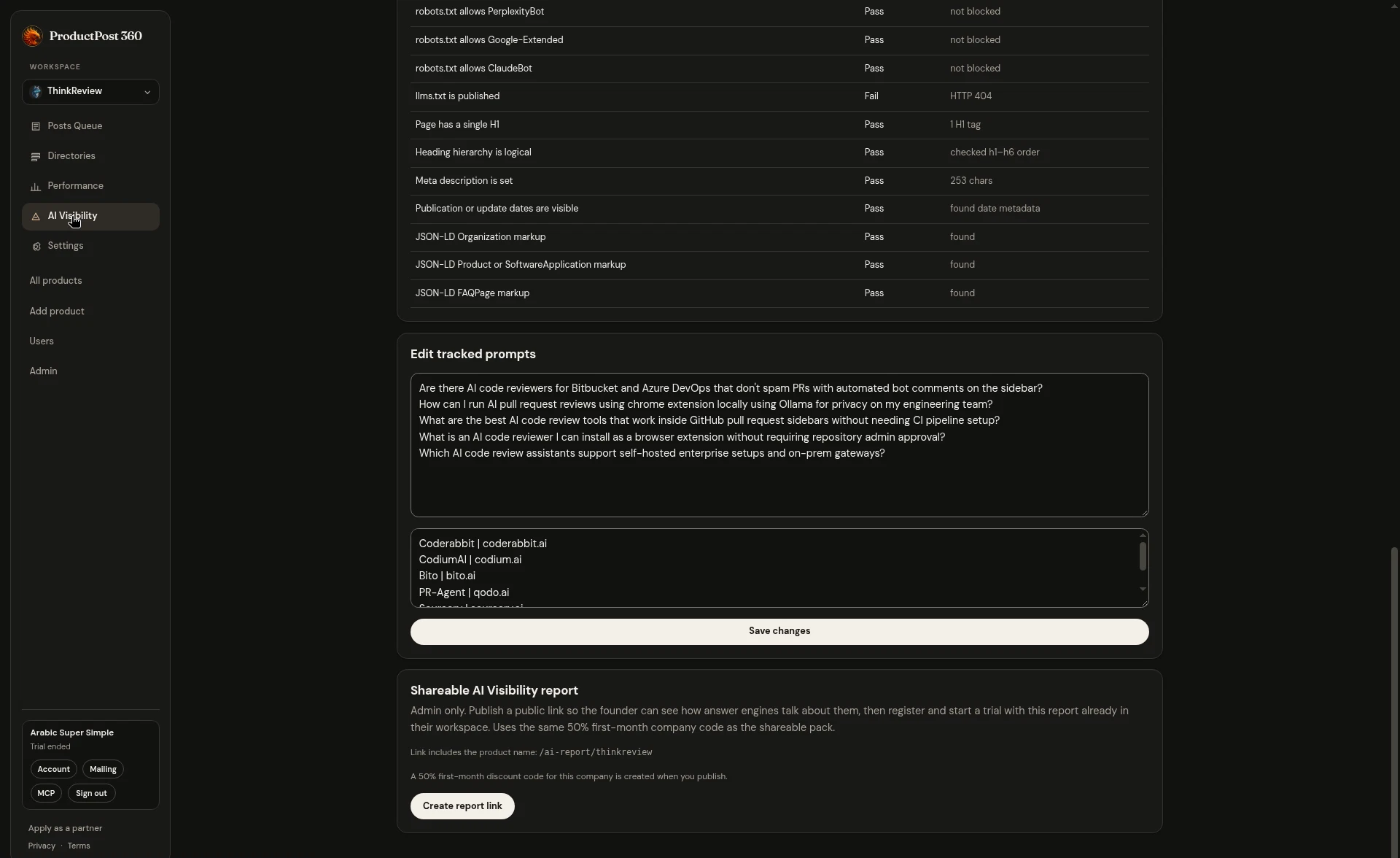
ThinkReview’s run in the shot passes the bots, the headings, the description, and the JSON-LD it has. llms.txt returns a 404. That is a file to publish at the root, describing the product in text. It is a small page. Shipping it does not move the mention rate by Friday. It removes a fail on a check you can re-run the hour you deploy.
Two different jobs
Use the audit when you change the homepage, the robots file, or the markup. A founder who blocked GPTBot while locking down a staging rule will see it here, on the production host the audit followed. A homepage with two H1s, or a description that is only the brand name, fails for a reason a designer can fix in an afternoon.
Use the prompts when you want to know what the engines say about the jobs your buyers ask. Those runs are on a cadence because the answers are expensive and slow to change. Re-running them after you add a meta description will mostly show you the same answers. Re-running the audit will show you the meta description.
The prompts editor sits on the same page, under the audit, because the questions are the other half of the setup. Save them when they sound like a buyer. The audit will not grade the prompts. It grades the page.
A link for someone outside the workspace
The shareable report publishes a public page of this check. A co-founder, an advisor, or a writer who does not have a login can see what the engines said and how the homepage scored. Publishing the link also creates a 50% first-month code for that product, the same idea as the shareable onboarding pack in settings.
Send the report when you want another person to see the gaps. Send the pack when you want them to see which drafts and channels exist. Neither link posts anything, and neither one replaces the pass you do yourself: fix the failed row you agree with, leave the optional ones, and let the next prompt run happen on its own clock.