 ProductPost 360
Blog
Searches that just showed up
Search Console on the performance page shows queries that appeared in this 28-day window, the pages behind them, and the days you posted drafts.

A new query is a search Google showed your pages for in the latest 28 days, and did not show in the 28 days before. It is the closest thing on the performance page to “something changed.” Clicks can stay flat while that list gets interesting, or the other way around.
Search Console on Performance is that window: a chart, the queries that are new, and the pages that collected the clicks. The screens are ThinkReview’s property. The reading is the same on any site you connect.
Two windows, and the days you posted
The chart compares the latest 28 days with the 28 before them. Dim bars are the earlier window. Bright bars are the current one. Dots mark days you posted drafts.
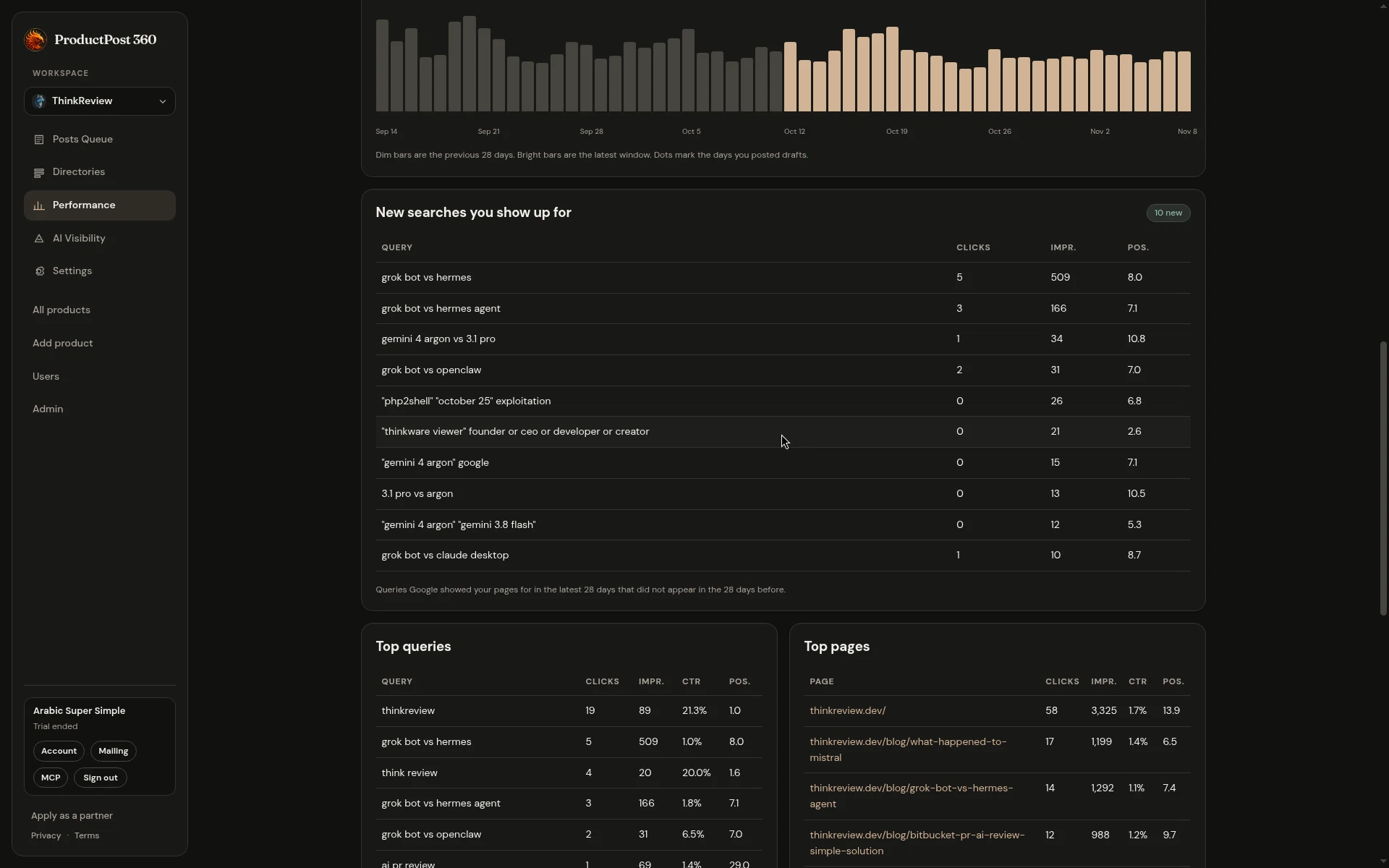
A brighter week that lines up with a dot is a hint, and only a hint. A post can coincide with a crawl, a newsletter, or a page that finally got indexed. Use the dot to ask what you published that week. Use the query table to see whether Google agreed.
Three kinds of new query
ThinkReview’s new list is mostly comparisons: one product against another, a model against a desktop app, a benchmark. A few have clicks. Most have impressions and a position somewhere down the first page or just past it. That mix is the useful part.
- Impressions, almost no clicks, position near the top of page two. The page is in the conversation and the snippet is losing it. Open the page, read the title and the description against the exact query, and change the sentence a searcher would see. That is a rewrite, and it is a small one.
- A few clicks on a comparison you already wrote. The post is earning the visit. The next draft in the posts queue should be that post, aimed at the room where people are still arguing the same pair of tools.
- A query with impressions and a position that is already strong, and zero clicks. Sometimes the query is curiosity about a person or a brand you do not need to chase. Leave it. A new row is information. It is not a mandate to publish.
Top queries and new queries answer different questions. Top queries are what already sends people, including your own name. New queries are what just started. A week spent polishing the brand query, while a comparison sits at position 8 with hundreds of impressions, is a week spent on the search you already won.
The page, not the keyword
Top pages sits beside top queries so the URL is obvious. On this property the homepage still takes the largest share of clicks. Individual posts take the comparisons. If a new query points at a post, edit that post. If it points at the homepage, the homepage is ranking for a question it may not answer, and a dedicated page will usually do the job more honestly.
Connect the property once in settings. After access is saved, a refresh uses that grant. The table is the latest stored window, and the brief further up the page will quote these queries when it recommends a snippet change or names an opening. The query list is where you check that the recommendation is about a real search, on a real URL, in this month.