 ProductPost 360
Blog
A week of decisions from the brief
Once a week the brief reads stored Search Console, Bing, Analytics, and backlink snapshots, then lists what to do next and which openings to notice.
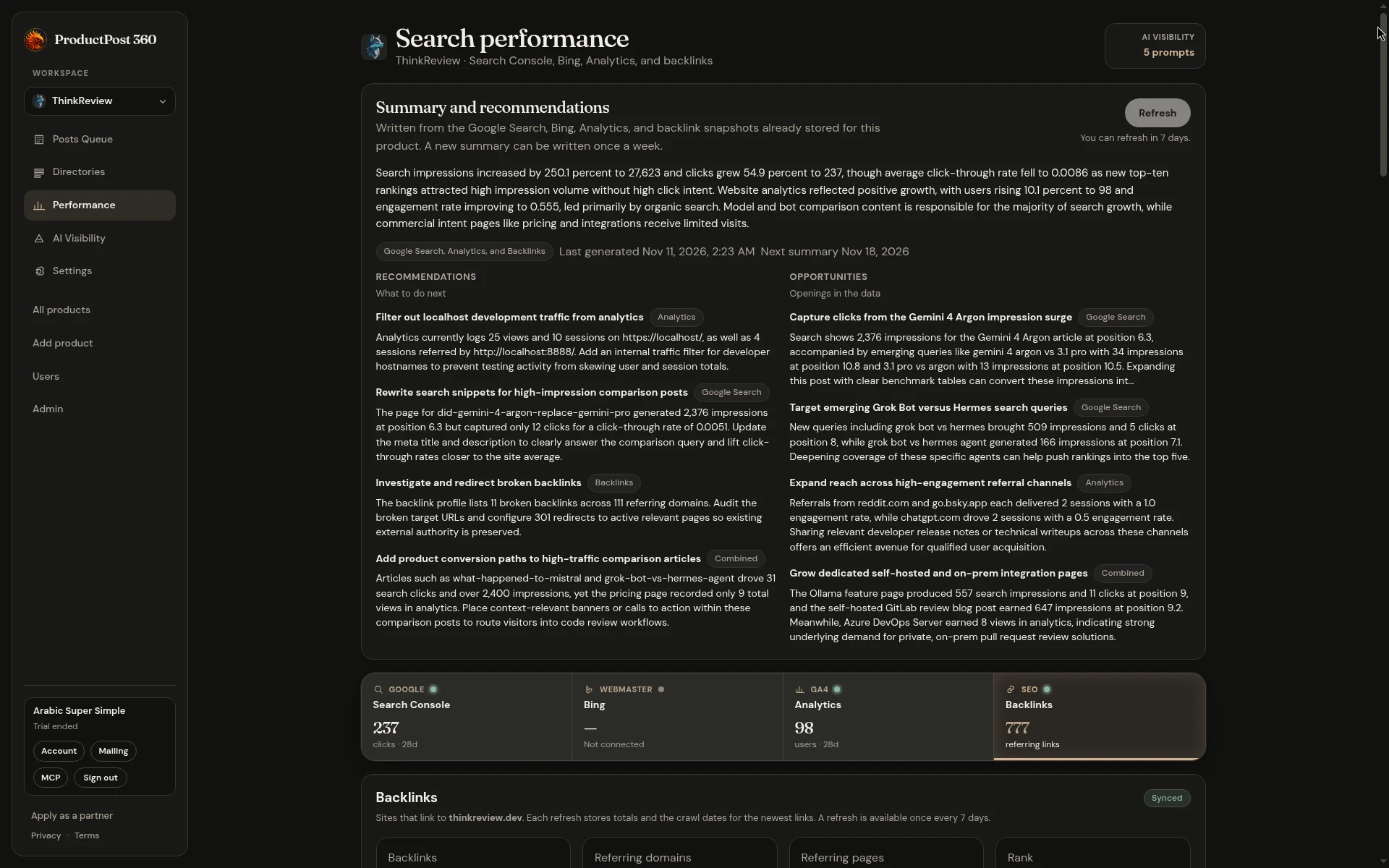
The charts on the performance page are snapshots. The brief is the note on top of them: a short summary, then recommendations, then opportunities. It is written from the Google Search, Bing, Analytics, and backlink data already stored for that product. A new one can be written once a week.
Four sources, one brief is why the sources disagree. This is how to spend Monday on the note itself. The example is ThinkReview’s latest brief. The labels on each card are the part to copy into your own week.
Recommendations are the next action
A recommendation is something the stored numbers support doing. Each card names the source, or says it needed more than one.
Four patterns show up often enough to plan around.
- Your own machines are in the analytics. Localhost and a preview host add users and sessions that are you, testing. Filter them at the property. Until you do, every “growth” sentence in the summary is partly a mirror.
- A page has impressions and a click rate near zero. The brief will name the URL and the query. The work is the title and the description a searcher sees, aimed at that comparison, and a look at whether the page answers it in the first screen.
- Backlinks point at URLs that 404. Redirect them. That recommendation is a backlinks card. It does not require a new post.
- A high-traffic article has no path into the product. The card is tagged as combined, because search sees the clicks and analytics sees the visits that leave. A single internal link, written like a next step a reader would want, is the change. A banner is how that card gets ignored.
Do the cards that name a URL you recognize. Skip a card that scolds a page you have already decided to leave alone. The brief is a list. You still choose.
Opportunities are openings
The right-hand column is the part of the data that looks like a door, and might still be early.
A query with thousands of impressions at a position just off the top is an opening: people see a result, and the result is not yet the one they choose. A cluster of comparison queries around two product names is the same opening, repeated. An engaged referral channel with almost no volume is an opening of a different kind. Someone stayed. Almost nobody else has been sent.
An opportunity is a reason to look at a page or a room. It becomes a draft when you have a source that helps a stranger. The posts queue is where that source already lives. Generate the draft from the post that matches the query. Leave the homepage alone if the homepage is not the page Google is showing.
When a source is missing
Bing, in this shot, is not connected. The brief says it was written from the sources it had, and the Bing card under the note stays empty. That is the correct silence. A missing property should stay missing, so the summary does not invent a second search engine.
Connect what you can, in settings, and refresh. Search Console and Analytics keep their grant after the first sign-in. Backlinks refresh on their own cadence, about every 7 days. The brief waits until the next week, so a single afternoon of refreshes does not produce a new essay.
Read the summary once. Then work the recommendations that name a real URL. The opportunities can wait until those are done, which is why they are a separate list.